Living Dharma 2026VU Amsterdam — Faculty of Social Sciences and Humanities
VU Amsterdam · 19–20 October 2026

Live Blog

Follow Living Dharma from pre-event preparation and the 24-hour online programme through the in-person conference at VU Amsterdam. After each session, this page will provide quick summaries, key insights and available live streams or recordings.

Pre-event · 11 September 2026

Hindu Perspectives on Spiritual Care

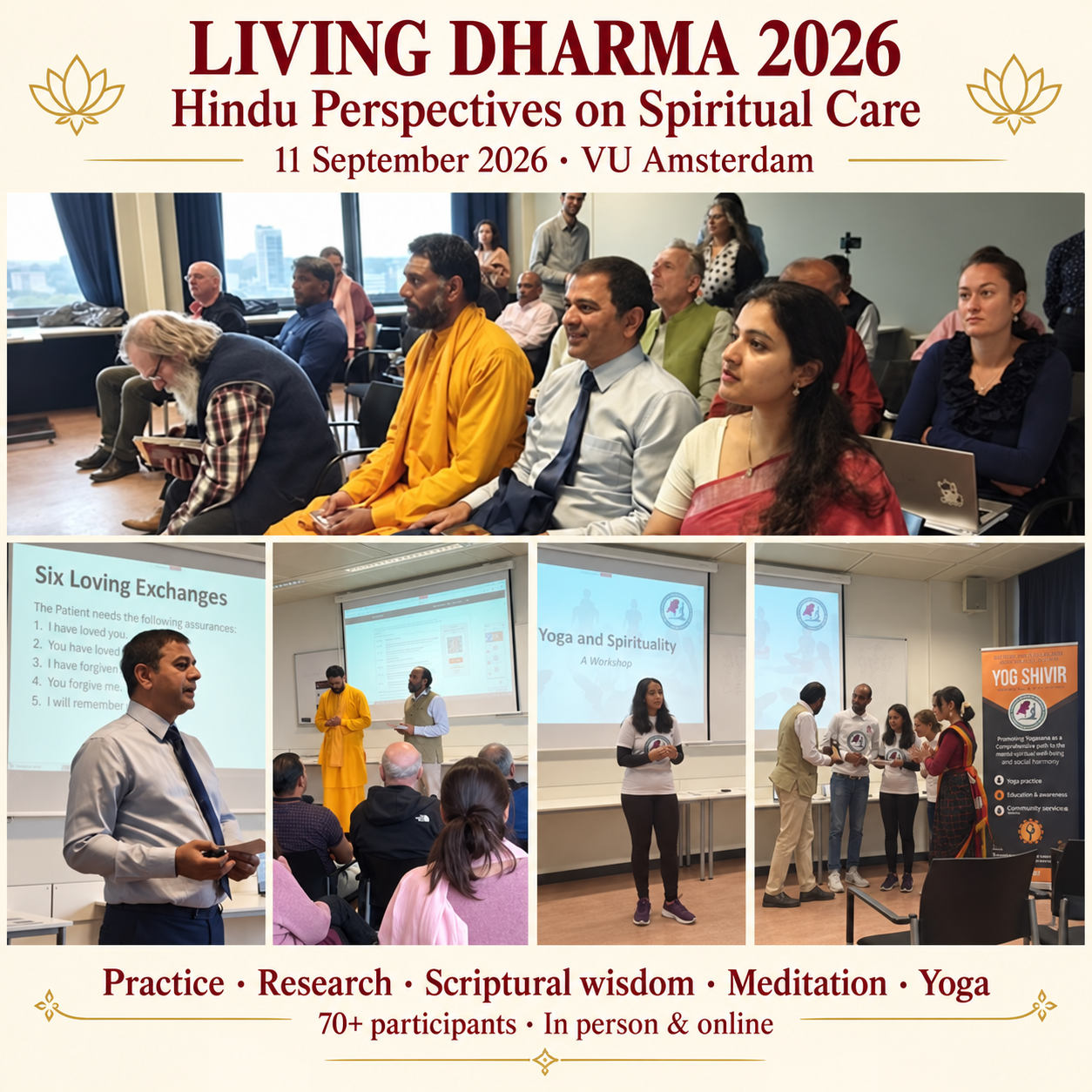
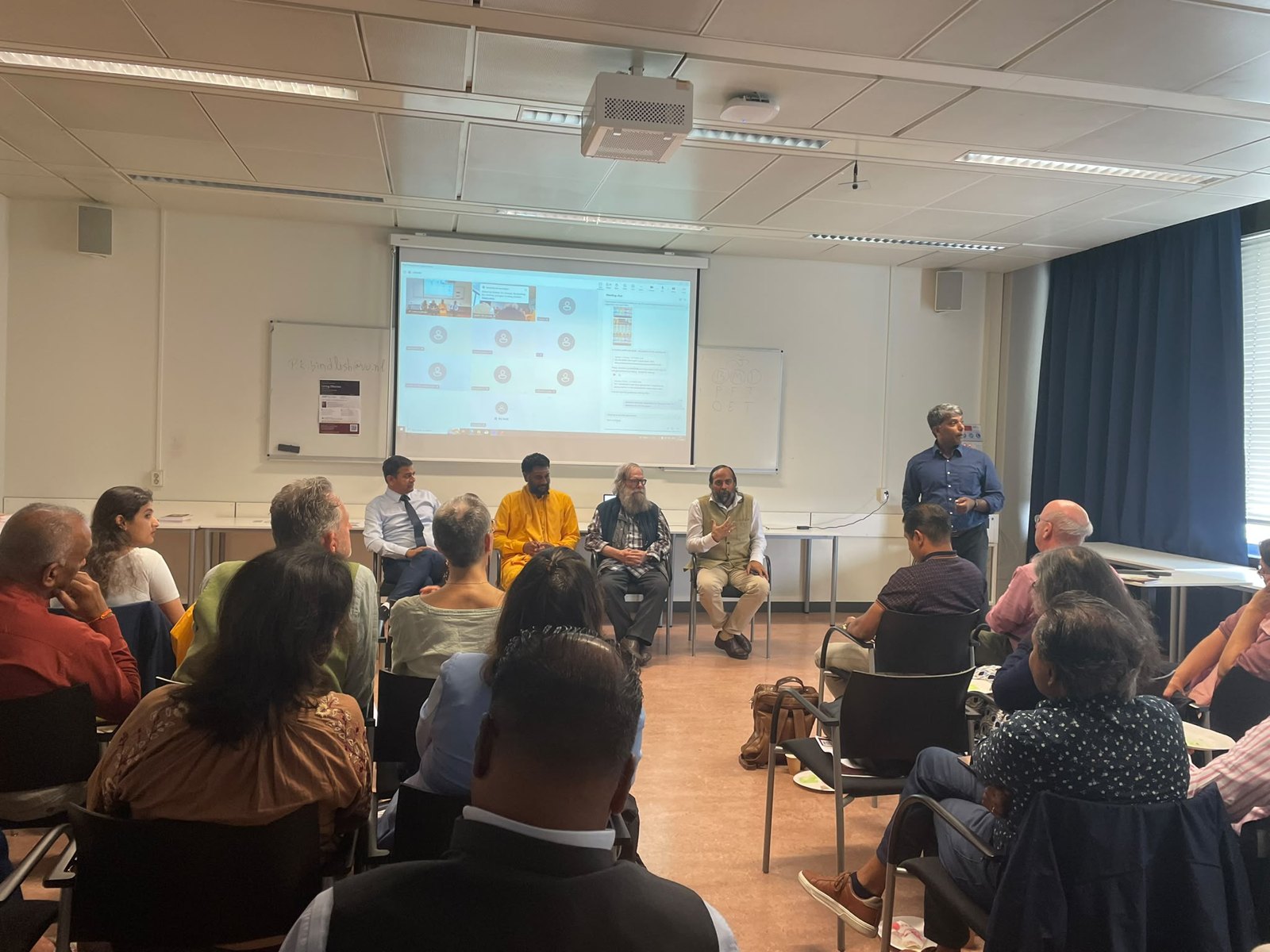
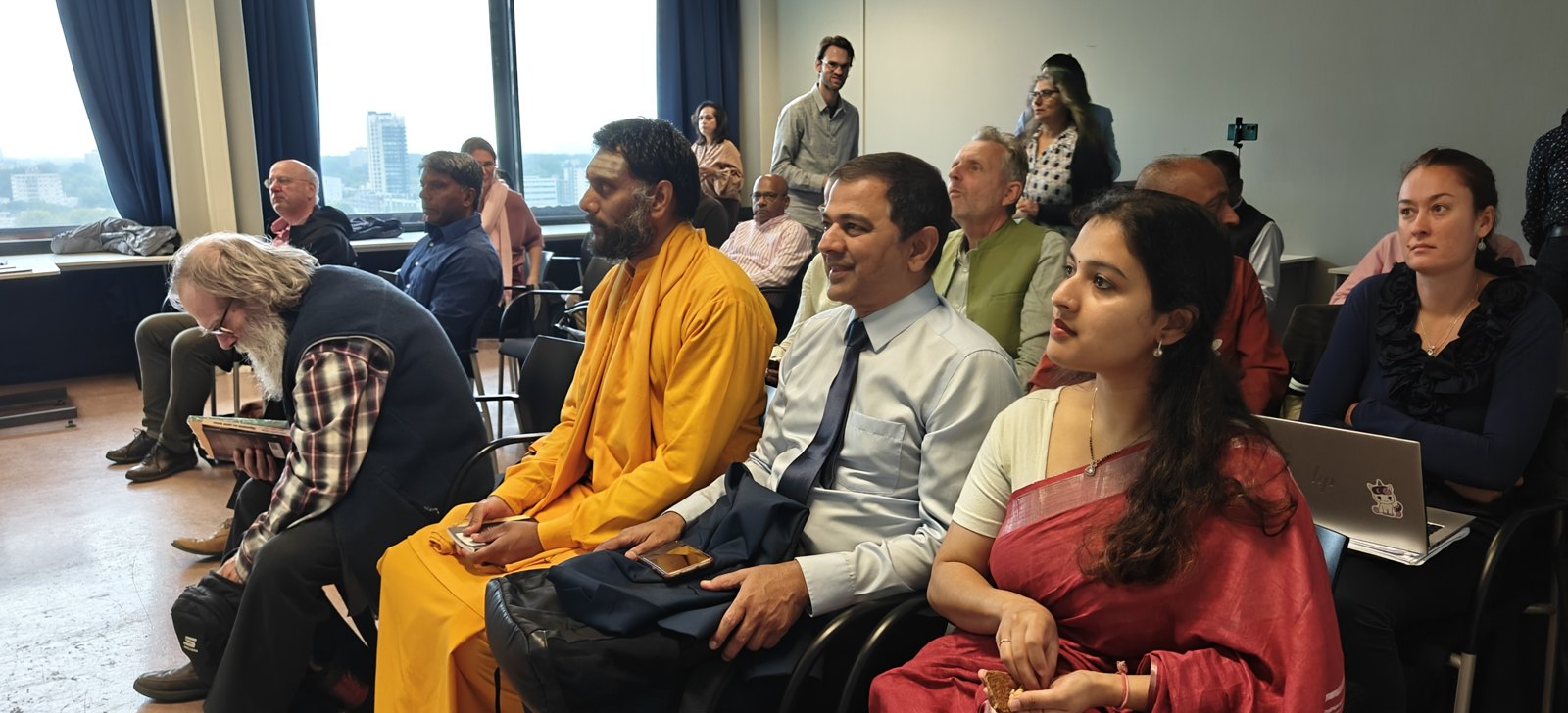
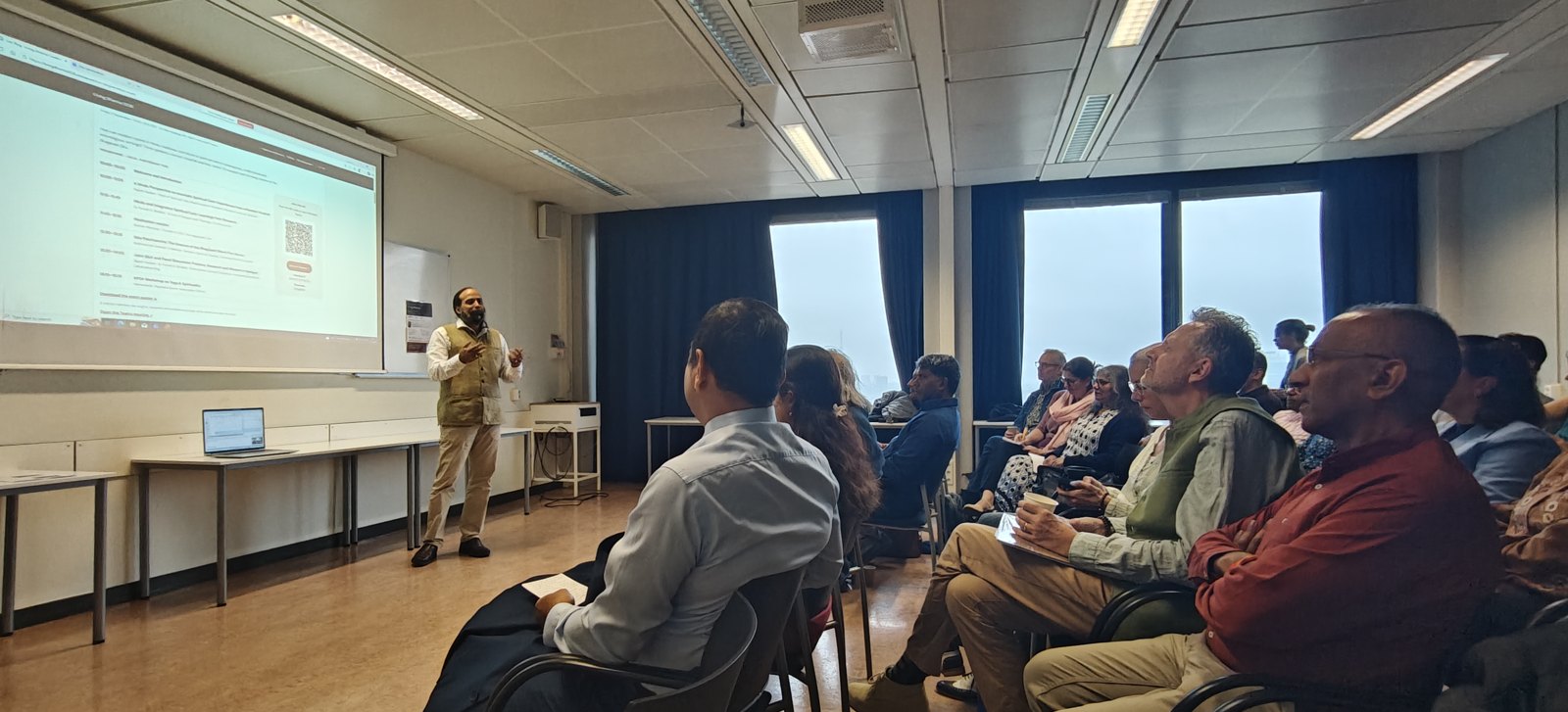
More than 40 participants joined in person and over 30 online on 11 September 2026. The gathering at VU Amsterdam brought hospital practice, academic research, scriptural wisdom, meditation and yoga into a shared conversation about spiritual care.

Hybrid pre-eventEvent report available

Hindu Perspectives on Spiritual Care

Watch the pre-event recordings

Watch the session recordings from 11 September 2026. Open the playlist menu in the player to choose an available recording.

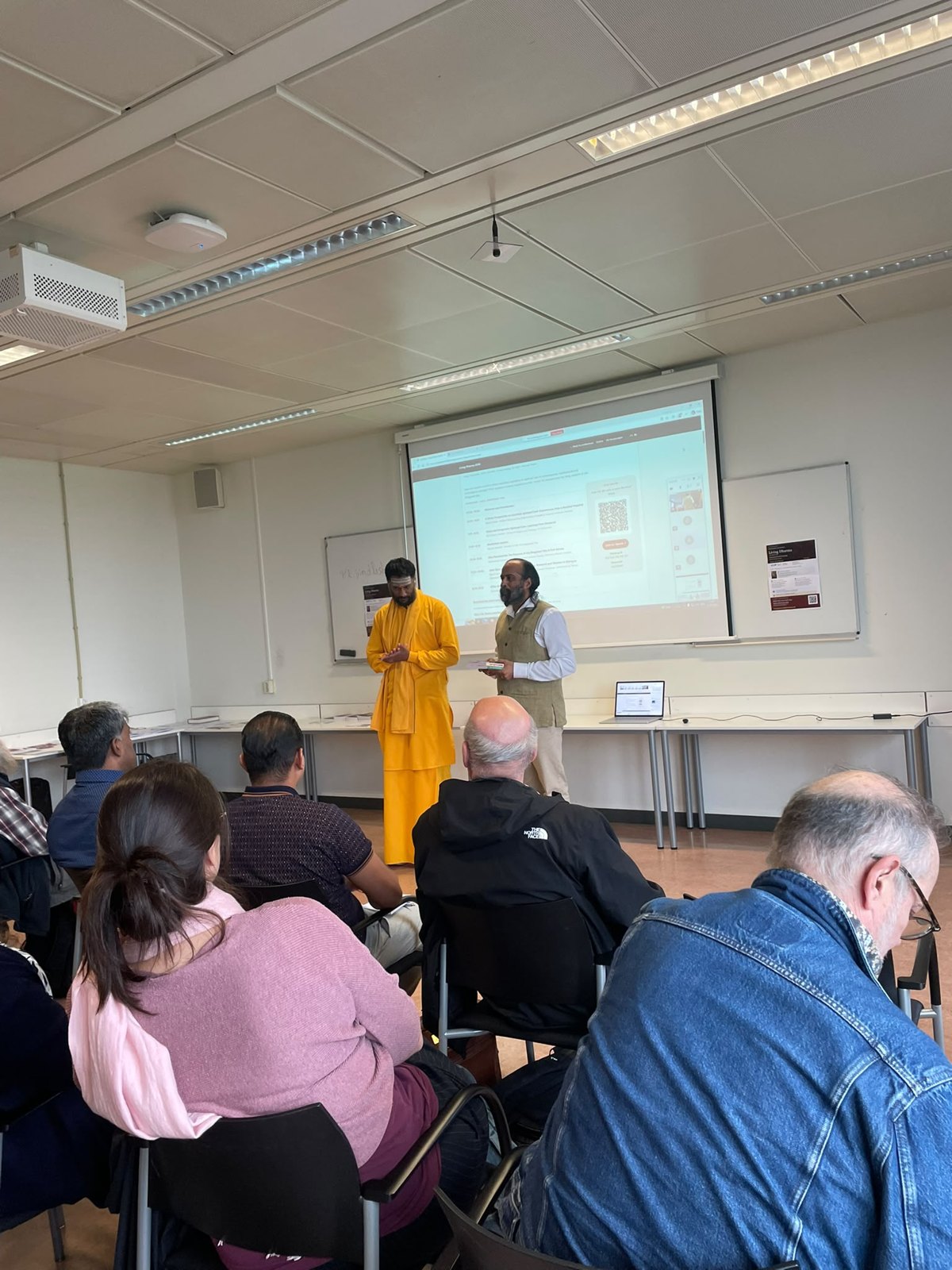
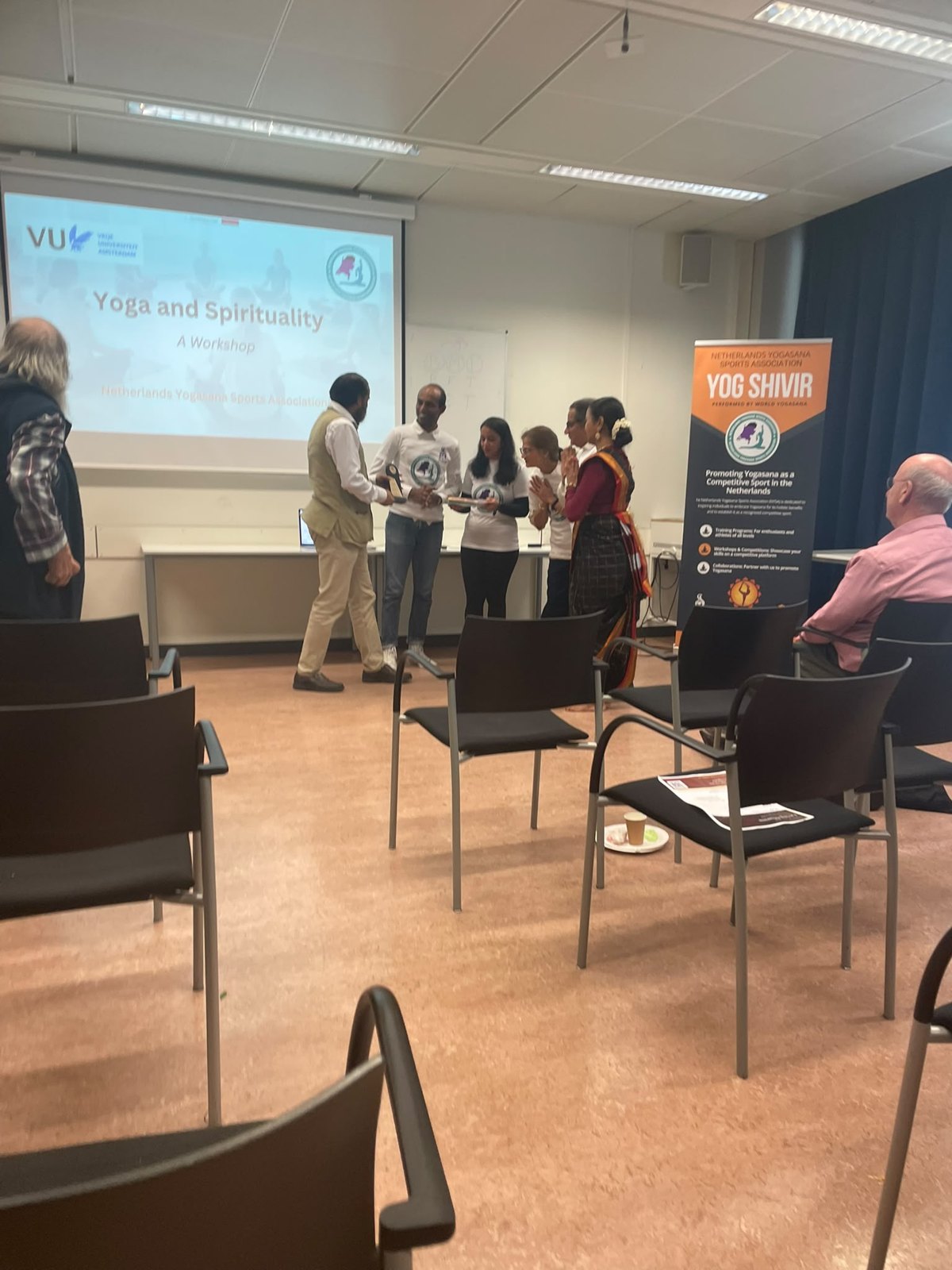
Living Dharma pre-event, 11 September 2026 at VU Amsterdam: a collage of the audience, presentations and yoga contributions

Highlights from the day

  • Opening and shared purposeProf. Sharda Nandram situated the day within the Hindu Seminary’s work in education, research and professional practice, connecting philosophy, texts, culture and lived experience.
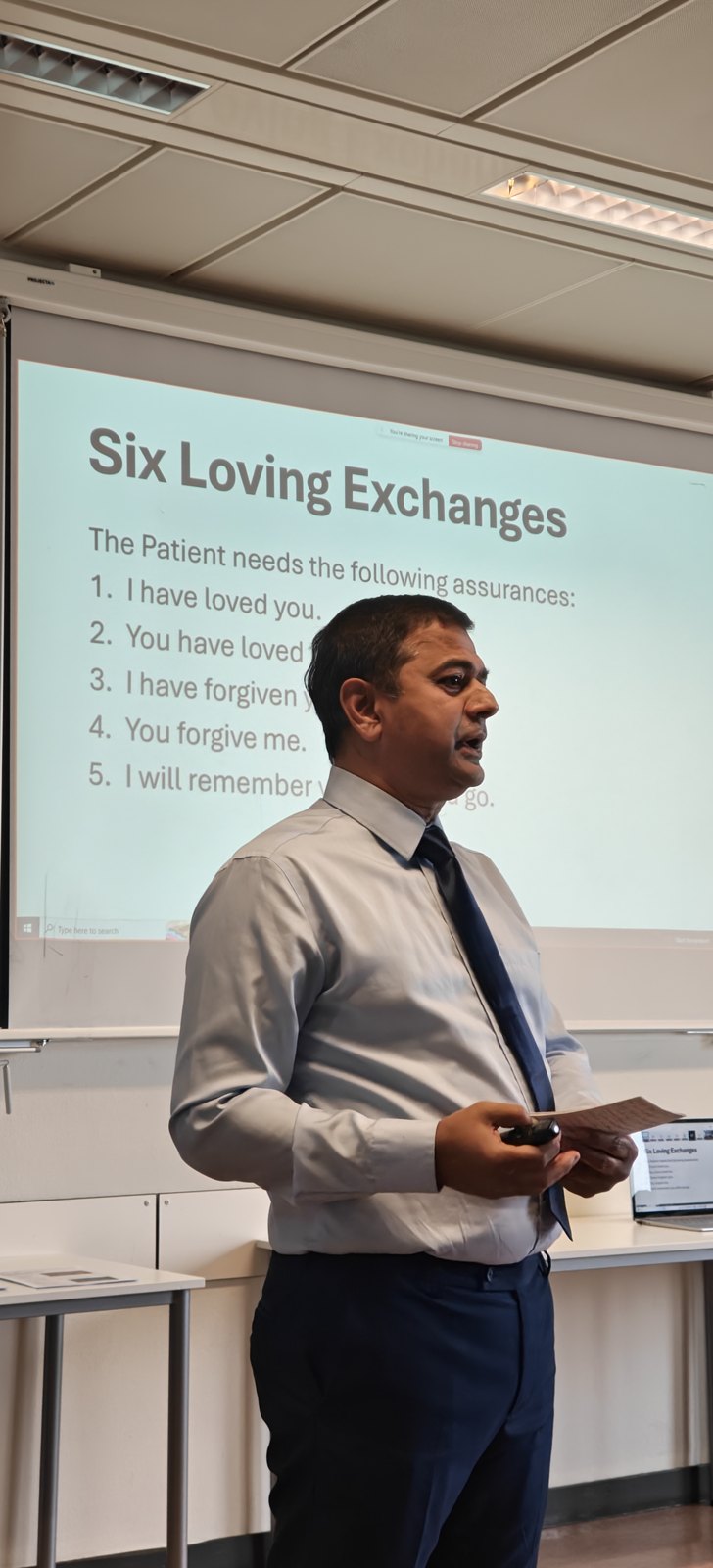
  • Care begins with the personRajesh Kadam drew on Bhaktivedanta Hospital’s experience to explain pancha kosha and care adapted to each patient’s faith and wishes. Responding to immediate practical needs, supporting families at the end of life and caring for caregivers were central themes.
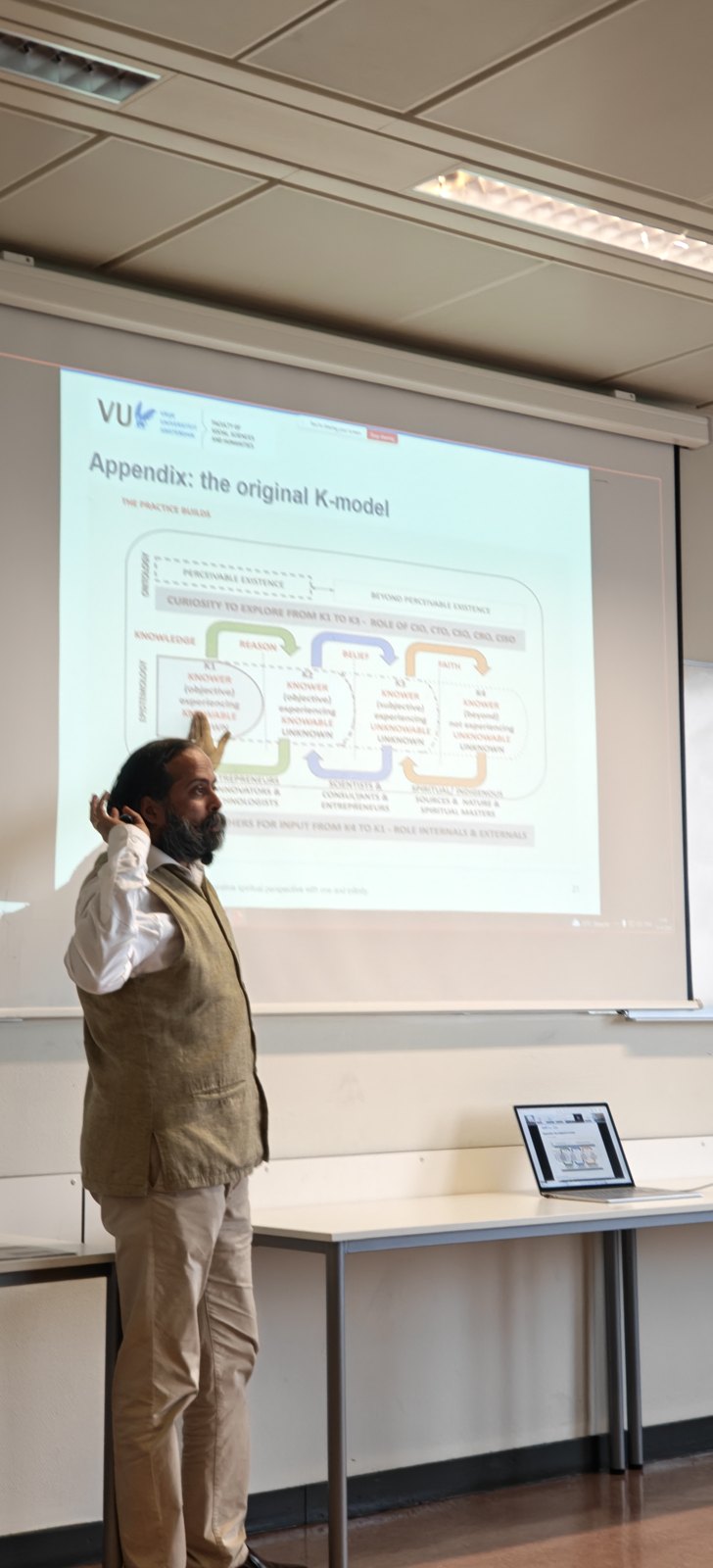
  • Research, dharma and ways of knowingDr Puneet K. Bindlish connected atman, karma and dharma with integrative spiritual care. The H-Framework addressed suffering and pathways beyond it; the K-model encouraged humility about what caregivers can know. Dialogue and attentive presence respect the care receiver’s own worldview.
  • The Bhagavad Gita in everyday lifeBrahmachari Somesh Chaitanya introduced Gita Panchamrita through Advaita Vedanta, exploring purposeful action, devotion and understanding. Participants reflected on wholehearted effort without becoming consumed by anxiety over results.
  • Professional care in dialogueBikram Lalbahadoersing moderated a discussion on listening, interfaith care, guilt, conflicting duties and caregiver well-being. The exchange highlighted professional judgement, context and respect for each person’s choices.
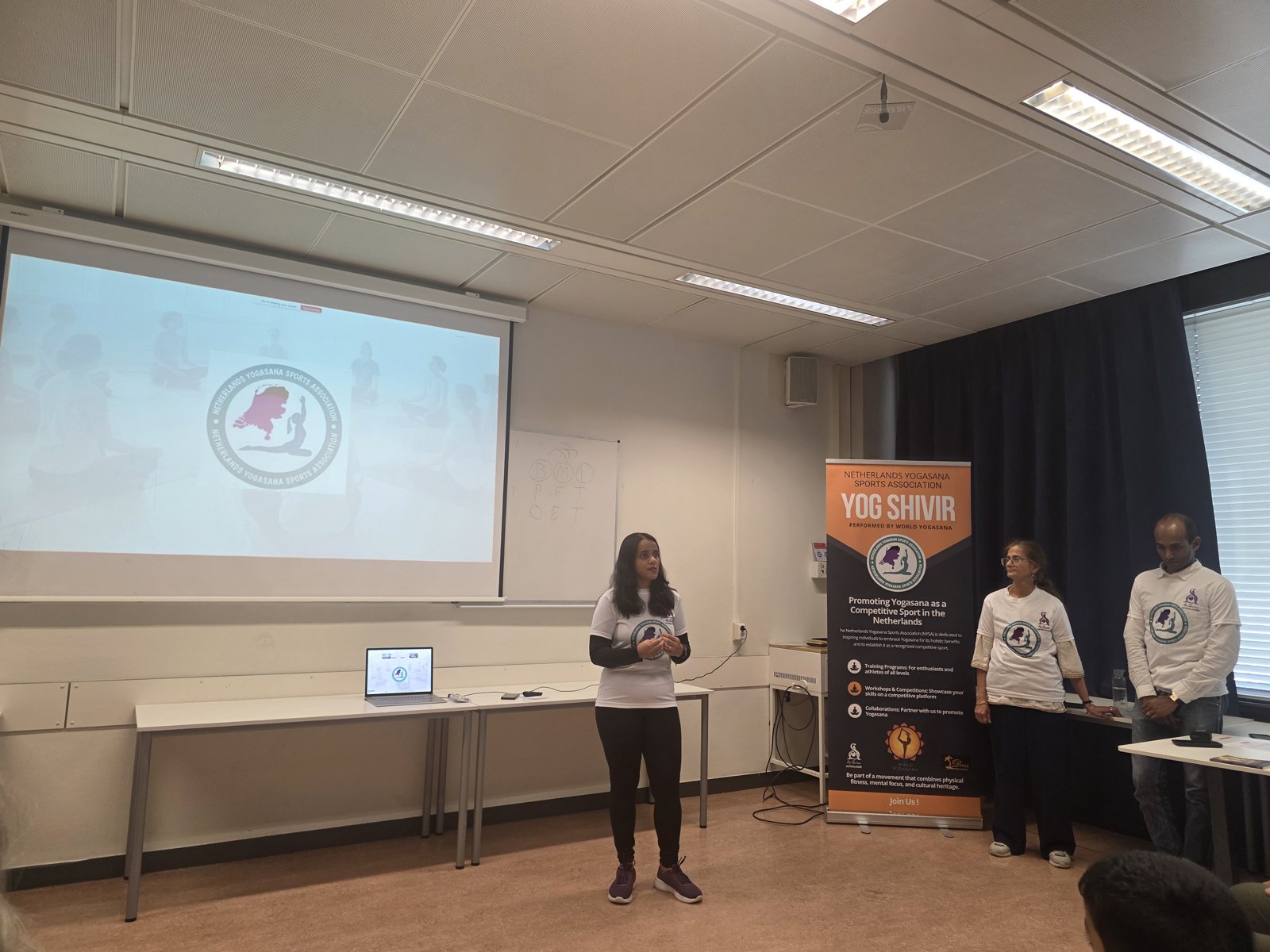
  • Meditation, movement and yogaNuthan Manohar guided movement, breath, AUM chanting and quiet awareness. NYSA contributors Ameya Krishna, Ashwini Pathak and Vandana Vyas brought dance, yogasana, breathing and meditation into the day’s shared practice.
  • Learning across traditionsA Sikh spiritual-care handout from Gursev Singh, who was unable to attend, was shared after the event and included in the report. It adds perspectives on unity, selfless service, community and resilience.

Thank you to all speakers, participants and volunteers. Continue the conversation at Living Dharma 2026 on 20 October.

View the conference programme →

For presentations or to share photographs and videos, contact p.k.bindlish@vu.nl.

View the original programme
Welcome and introduction
A Hindu Perspective on Interfaith Spiritual Care: Experiences from a Mumbai HospitalRajesh Kadam · Head of Spiritual Care, Bhaktivedanta Hospital & Research Institute, Mumbai
Hindu and Integrative Spiritual Care: Learnings from ResearchDr Puneet K. Bindlish · School of Religion and Theology, VU Amsterdam
Meditation sessionNuthan Manohar · Founder & CEO, The Happiness Tour
Gita Panchamrita: The Essence of the Bhagavad Gita in Five VersesBrahmachari Somesh Chaitanya · Resident Spiritual Teacher, Chinmaya Mission Sweden
Joint Q&A and Panel Discussion: Practice, Research and Wisdom in DialogueRajesh Kadam · Dr Puneet K. Bindlish · Brahmachari Somesh Chaitanya · moderated by Bikram Lalbahadoersing
NYSA Workshop on Yoga & SpiritualityNetherlands Yogasana Sports Association (NYSA)
19–20 October · CET

24-hour online programme

Quick summaries and media from global panels, talks, workshops, hackathons and organisation showcases.

Online research sessionAbstracts available · Session upcoming

MSR Paper Presentations: Dharma, education, leadership and governance

Explore the submitted abstracts for the opening four presentations in the Special track on Living Dharma – Spirituality in Management. These papers consider how Dharma can inform higher education, ethical practice, responsible leadership and public policy.

Moderators: Raysa Geaquinto Rocha (VU Amsterdam · The Open University) and Elham Malik.

Before the session: this is an abstract preview, not a report of delivered presentations. The short introductions below are editorial summaries; the expandable sections contain the authors’ submitted English abstract text, with spacing adapted for the web. Bibliographies, illustrations and material outside the abstracts are not reproduced. Session coverage and any available recordings can be added after the event.

Priyanka Dutt

14:10–14:25 CEST / CAT · 17:40–17:55 IST

Knowing, Being and Acting: Svadharma as an Ontological Architecture for Higher Education

Priyanka Dutt

Banasthali Vidyapith, India

An exploration of svadharma as a way to reconnect knowledge, personal formation and responsible action in higher education.

Read the submitted abstract

Alan Wallace mentions, citing German physicist Carl Friedrich von Weizsäcker, “the modern scientific enterprise has been the pursuit of knowledge without love—an approach to inquiry devoid of ethics and altruism that has yielded unprecedented power alongside the greatest inhumanity and environmental destruction in human history”.

Recent higher education research argues that universities have overemphasized information, productivity and technical performance while under developing moral formation, reflective judgement and the capacities needed to use knowledge responsibly (Maska et al., 2026; Guzmán, 2026; Case & Tyler, 2025; Schweizer, 2026). The context of higher education is indicating not only a crisis of knowledge production or technological capability but also a crisis in the fractured relationship between knowledge, responsibility and human flourishing (Stewart et al. 2022; Maska et al. 2026; Guzmán, 2026; Chaytor & Tomaney, 2025).

This fragmentation calls for an understanding of higher education in which knowledge is not treated as separate from the person who acquires, interprets and applies it, but as a part of the educational process directed towards human flourishing, ethical discernment and responsible agency (Bhawuk, 2020; Schinkel et al., 2023). Also, higher education learning may be understood as a process through which individuals in addition to competence also develop the capacity to connect knowledge, self-understanding, responsibility and conduct (Bhawuk, 2020; Nandram & Bindlish, 2025). This orientation is consistent with the view that education should cultivate reflective and responsible persons whose intellectual development is connected with the ethical use of knowledge (Calvert et al., 2024; Lolla, 2021). Additionally, a pattern can be observed across dharma, virtue informed & holistic education studies, that moral growth is strongest when duty, reflection, and action are integrated and governance is strongest when values are built into routines, evaluation, and shared responsibility (Isser et al, 2024; Yadav, 2025; Wang et al, 2026; Polla & Sophoeun, 2026).

Within this frame, Svadharma can serve as an architectural principle for higher education as it joins knowing, being and acting within one moral ontology, then translates that ontology into pedagogy, institutional purpose and governance (Mahato & Roy, 2026; Chouhan, 2026; Baral & Giri, 2025; Agrawal, 2026; Dhakal, 2022). Studies confirm that svadharma extends private self-discovery to aligned duty with self knowledge, social responsibility and non-attached action which expands education from content delivery to ethical formation (Sharma, 2025; K., 2025; Basantia & Das, 2025). Literature supports this architecture conceptually, especially when svadharma is read through Gita-centered Indian traditions and recent dharma based education work rather than as a narrow rule of role conformity (Ramachandran, 2020; Frazier, 2021; Isser et al. 2024).

The Bhagavd Gita translations of Śaṅkarācārya and Rāmānujacharya place svadharma within a relationship among self, action and a wider order of meaning (Śaṅkarācārya, trans. 1983; Rāmānuja, trans. 1962). Svadharma is defined here as one’s own responsibility aligned with one’s nature, capacity, role, social and cosmic context rather than private preferences alone (Kumar, 2025; Rastogi, 2018; Gupta & Sharma, 2025). It sits within a wider dharmic order because dharma is portrayed as a connected moral-cosmic framework and svadharma is the point where the larger order becomes concrete for the person in a particular situation (Tuli & Gupta, 2024; Bhangaokar & Kapadia, 2009; Mahato & Roy, 2026). The literature treats svadharma as contextual and dynamic shaped by time, situation, life stage, and social situation rather than as a fixed inner preference (Bhangaokar & Kapadia, 2009; Rastogi, 2018; De Mondal, 2024; K, 2025).

Svadharma, here is therefore, understood as principle of ontological coherence, a responsibility that must be discerned through the relationship between personal capacities, circumstances, and wider ethical context of action (Bhawuk, 2020; Nandram & Bindlish, 2025). This ontological coherence can be extended into areas of leadership, applied education and spirituality (Dutt et al, 2013; Pardasani et al. 2014; Bhawuk, 2019; Frazier, 2021).

Peer-reviewed studies in higher education suggests the application of such an ontology to be translated into institutional form: This svadharma informed pedagogy has four recurring features: Ethics integrated into curricula, reflection, exemplification, peer reinforcement, disciplined practice, supervision and evaluation with lived ethical formation (Nandram, 2014; Barabash et al. 2025; Lapsley, 2025, Sahu, 2026; Sasi & Manjula, 2026). Various approaches inculcated in the Reflection mechanism include ethical case analysis, meditation, self-inquiry, journaling and metacognitive articulation of moral frameworks (Rastogi, 2018; Lapsley, 2025, Tsepkova, 2025). Exemplification appears in the guru-teacher model, in Gandhi's enacted Gita (Calvert et al, 2024, Mclain, 2019). Peer-reinforcement in community learning, service learning and volunteer activity across classroom/ extracurricular life (Chouhan, 2026; Tsepkova, 2025, TSVYK, 2021). Disciplined practice appears in karma yoga, repeated effort, self management and habit reformation (Mclain, 2019; Chapple, 2021; Agarwal et al. 2023). In institutional terms, educators move beyond content delivery, responsibility aims are built into curriculum strategy and evaluative life so ethical formation becomes lived university process rather than a curricular add-on (Isser et al. 2024; Lapsley, 2025; Yadav, 2025; Chaytor & Tomaney, 2025; Nandram et al. 2026). A svadharma informed pedagogy responds to the crisis by treating knowing, being and acting, as integrated and by recasting education as the formation of self-knowledge, ethical responsibility and social purpose apart from transmission of skills alone (Mahato & Roy, 2026; Chouhan, 2026; Yadav, 2025; Saha, 2025, Bindlish et al. 2025).

Keywords: Svadharma, Higher Education, Ontology, Holistic Pedagogy, Values-based Education

Sudarsana Venugopalakrishnan

14:25–14:40 CEST / CAT · 17:55–18:10 IST

Echoes of the Thunder: A Comparative Study of Ethical Praxis in the Brihadaranyaka Upanishad and T.S. Eliot's The Waste Land

Sudarsana Venugopalakrishnan

PhD Research Scholar, Department of Philosophy, University of Mumbai

A comparative reading of the Upanishadic “Da Da Da” and T. S. Eliot, exploring self-control, giving and compassion as responses to contemporary ethical challenges.

Read the submitted abstract

Aim: To explore the ethical dimensions presented in T.S Eliot’s “What the Thunder Said” from the lens of Vedic Philosophy in Brihadaranyaka Upanishad.

Objectives: (i) Exploration of the Philosophical perspective presented in T.S Eliot’s “What the Thunder Said” especially the final climatic verse of “Da Da Da”. (ii) Understanding the perspective of “Da Da Da” from Brihadaranyaka Upanishad. (iii) Finding a synthesis of Ethical Praxis, Relative Allusions and Contemporary Applications in both the works.

Research Methodology: Conceptual, Comparative, Pragmatic Paradigm.

Discussion: In Brihadaranyaka Upanishad, (Fifth Chapter, Second Brahmana), Prajapati give a three-fold solution to his three groups of children, namely the Gods, Humans and Demons. This starts as a one syllable lesson comprised of the letter “Da” which is interpreted differently by the different children. The interpretation is seen differently based on the various values, thought systems and ethics of the different group. These are stated as the three disciplines of self-control namely: Da – Damyata – Self Control – By the Gods, Da – Datta – Give/ Let Go – By the Humans and Da – Dayadham – Compassion – By the Demons.

This same thought has been reflected in the Poem, “What the Thunder Said” final section “The Wasteland” of T.S Eliot which is the solution which the thunder presents to the problem that lies ahead of spiritual famine and philosophical barrenness.

Conclusion: There are definite symmetry and synthesis in T.S Eliot’s work when seen from the lens of Vedanta Praxis. The cohesiveness of the thought in citing the literal thunder of Prajapati which gives the solution can be seen as a melting pot of ethical arbiter for healing a broken world due to its many vices. This paper will seek to explore this merger of thoughts from the joint lens of modern contemporary problem and ancient values.

Keywords: Ethics, Upanishad, Thunder, Vedanta

The Sanskrit quotation in the submitted abstract is not reproduced in this text version.

Commodore Sunil Kumar

14:40–14:55 CEST / CAT · 18:10–18:25 IST

Dharma as the Core of Responsible Leadership

Commodore Sunil Kumar

Retired

A three-part approach to responsible leadership: a purposeful life, responsibility beyond self-interest, and the cultivation of self-control through yogic practice.

Read the submitted abstract

Responsible leadership is the need of the hour, not just for academic discussions, but also for a global dialogue on the sustainability of human life on the planet. It is not uncommon to see the leadership-thought-leaders attributing the existential global crises of climate change, pollution, corruption, financial scandals, and overexploitation of resources to the misplaced assumptions, models and objectives of the modern management, especially the leadership, discourse. It is also a well-accepted fact that business education is amoral, it only prepares people for a brutal capitalist world. It does not integrate aspects related to ethics, impact of management decisions on the organisation, society and world at large. It is, therefore, important to bring suitable changes into the leadership education so that we develop ethical leaders.

This paper proposes that Dharma based on the Indian Knowledge System (IKS) can address the root cause of the above problems through a simple three-step approach. The first step is to develop a suitable philosophical outlook among the leaders that guides them to lead a life of purpose and meaning. The second step is to create leaders who place organisational, societal and humanity interests above their personal interests. The third step is to develop the quality of Sanyam, self-control, through yogic practices of Dharana, Dhyaan and Smadhi, so that leaders are able to manage ego’s cravings for power, glory and status.

Life of Purpose and Meaning. Modern leadership scholars such as Professor Bennis view leadership education as a form of holistic development that helps individuals lead purposeful lives. However, contemporary leadership discourse says little about the purpose of life itself. The Indian Knowledge System (IKS) offers a rich philosophical basis for addressing this question. As per IKS, the purpose of human life, or Purusharth, consists of four aims: Dharma, Artha, Kama and Moksha. Dharma involves performing one’s duties righteously in accordance with universal principles of balanced living. Artha refers to the pursuit of material well-being, Kama to the fulfilment of legitimate desires, and Moksha to liberation from the cycle of birth and death. These four aims are deeply inter-connected. Wealth and desire must be pursued in accordance with the principles of Dharma. Dharma does not classify actions rigidly as good or bad; instead, it guides individuals to act appropriately in a given context. When necessary, textual prescriptions may be set aside for the larger good of society. Purushartha therefore offers a strong framework for a balanced, purposeful and meaningful life. Modern leadership education should incorporate this concept and emphasise the integration and balance of the four aims of life. Leaders must uphold Dharma while pursuing production, profits and organisational goals.

Hierarchy of Interests. In an interconnected world, interest of individuals constantly interacts with those of their family, community, society, nation, and humanity. Whilst some be in harmony, there are also conflicts in many cases. Dharma has a well-developed body of knowledge to address these conflicts by establishing a clear hierarchy starting from the individual (self) to the humanity. Dharma states that individuals are to sacrifice their interests for those of family, of family for community, of community for society and of society for humanity. This establishes an effective value system and provides clear directions for conduct in real-life. This doctrine of hierarchy is in sharp contrast to the principles of modern management and capitalism that seek to maximise profits and production without any consideration to the impact on organisation, society, and humanity as a whole. The single-minded pursuit of profits and production has led to corruption, greed, over-exploitation of resources, pollution, and climate change.

Self-Control or Sanyam. Many modern leadership thinkers also acknowledge that ego is the biggest enemy of leadership. However, the modern leadership discourse does not pay adequate attention to managing this biggest enemy. On the other hand, the IKS has a rich body of knowledge that defines the meaning of self-control, its constituents, and various practices to develop self-control. Self-control is developed by realising that we are not just the body, mind and intellect but also the soul. While the body mind and intellect are changing based on external stimuli, soul is pure and changeless. Hence, we must connect all sense organs to the soul. This alignment and connection of the sense organs to the soul is achieved through Dharna, Dhyaan and Smadhi. When we achieve all three, we attain Sanyam, that is control over all sense organs. Arth Shastra, the IKS text on material wellness and governance, also places the highest importance on this virtue. As per Arth Shastra, a leader should be wise like a sage, should achieve self-control by renouncing of six senses and by giving up anger, lust, greed, conceit, arrogance, and foolhardiness.

Keywords: Dharma, IKS, Purusharth, Sanyam

Nisha Pandey

14:55–15:10 CEST / CAT · 18:25–18:40 IST

From Dharma to Public Policy: A Research Framework for Reading the Vālmīki Rāmāyaṇa in Contemporary Governance

Nisha Pandey

Advisor, Department of Development Studies, Vivekananda Global University

A framework connecting readings of the Vālmīki Rāmāyaṇa with ethical leadership, accountability and public welfare, alongside evidence-based and constitutional governance.

Read the submitted abstract

Public policy is generally examined through institutions, evidence, incentives, and administrative capacity. Yet policy also requires a normative basis for deciding what public authority ought to pursue, whose interests should be protected, and how collective welfare should be defined. This paper examines the Vālmīki Rāmāyaṇa as a civilizational source for the normative study of public policy rather than as a literal administrative manual. Using selected episodes across the six Kāṇḍas, the study interprets dharma through contemporary concepts of ethical leadership, institutional accountability, collective action, environmental governance, diplomacy and welfare. The analysis particularly examines the Rama–Bharata dialogue in Ayodhyā Kāṇḍa, collective response to Ravana in Bāla Kāṇḍa, the Bhagiratha narrative, Hanuman’s mission in Sundara Kāṇḍa, and the idea of Rāma Rājya. The paper develops a Dharma-Oriented Public Policy Framework comprising Satya, Dharma, Nyāya, Loka-saṅgraha, Sevā, Karuṇā, and Tyāga. These principles are mapped onto problem definition, policy design, implementation and evaluation. The central argument is that dharma can complement evidence-based and constitutional governance by supplying an ethical criterion for judging legitimacy, responsibility, justice and public outcomes.

Keywords: Vālmīki Rāmāyaṇa; Dharma; Public Policy; Ethical Governance; Rāma Rājya; Indian Knowledge Systems; Public Administration; Collective Welfare; Policy Evaluation

The session continues

Break: 15:10–15:20 CEST / CAT (18:40–18:50 IST). The following six presentations keep their published times.

  • 15:20–15:35 CEST / CAT · 18:50–19:05 IST
    Prof Ramya Venkateswaran — Indigenous management: Possibilities in research and andragogy
  • 15:35–15:50 CEST / CAT · 19:05–19:20 IST
    Dr Siddhartha Saxena — Managed by algorithm, searching for meaning: workplace spirituality under algorithmic management
  • 15:50–16:05 CEST / CAT · 19:20–19:35 IST
    Dr. Sadhna Sargam with co-author Prof. Anita Mendiratta — Wisdom in Leadership: A Mindful Approach towards Responsibility
  • 16:05–16:20 CEST / CAT · 19:35–19:50 IST
    Dr Shreya Katyayani — Faith in Exile: Girmitiya Worlds across Kala Pani
  • 16:20–16:35 CEST / CAT · 19:50–20:05 IST
    Puja Jha — Cognitive Polarity through Samkhya's and Yoga Darshana's perspective
  • 16:35–16:50 CEST / CAT · 20:05–20:20 IST
    Aparna Singh — Dharma, Kingship, and Ritual Sovereignty: Governance as a Spiritual Order

This preview includes only the four abstracts supplied for publication.

Online panelTo be published after this session.

Panel discussions

Live stream or recording will appear here
YouTube Live · Microsoft Teams · recording

Post-event summary

A concise account of the principal questions, perspectives and points of connection will be added after each panel.

Space for key insights, quotations, resources and follow-up actions.
Open live stream or recording ↗
Online talkTo be published after this session.

Talks and keynote contributions

Live stream or recording will appear here
YouTube Live · Microsoft Teams · recording

Post-event summary

Short summaries will capture the central idea, its relationship to Living Dharma and suggested paths for further reflection.

Space for key insights, quotations, resources and follow-up actions.
Open live stream or recording ↗
Online workshopTo be published after this session.

Interactive workshops

Live stream or recording will appear here
YouTube Live · Microsoft Teams · recording

Post-event summary

Facilitators’ questions, participant insights and practical exercises will be documented here after the sessions.

Space for key insights, quotations, resources and follow-up actions.
Open live stream or recording ↗
Online hackathonTo be published after this session.

Living Dharma hackathons

Live stream or recording will appear here
YouTube Live · Microsoft Teams · recording

Post-event summary

Challenge statements, emerging solutions and follow-up actions will be presented in a concise post-event update.

Space for key insights, quotations, resources and follow-up actions.
Open live stream or recording ↗
Organisation showcaseTo be published after this session.

Dharmic organisations showcase

Live stream or recording will appear here
YouTube Live · Microsoft Teams · recording

Post-event summary

Participating organisations and their contributions to community life will be introduced here.

Space for key insights, quotations, resources and follow-up actions.
Open live stream or recording ↗

In-person programme · 20 October

Report will follow after the session.

Research showcase tour & informal lunch

Guided presentation of publications, current research, Hindu Seminary courses and selected OMRISE articles.

Add to calendar (.ics)

Report will follow after the session.

Registration & welcome

Check in and continue to the main plenary.

Add to calendar (.ics)

Report will follow after the session.

Opening ceremony & cultural welcome

Ceremonial lamp lighting, Vedic Swastivachan (by Sukhada) followed by a classical dance tribute (by Ashwini Pathak).

Opening blessings (approximately 13:40–14:00), also with Girish Momaya · MERU Netherlands.

Add to calendar (.ics)

Report will follow after the session.

Keynote: Living Dharma in a Changing World

By Sharda Nandram, author of Rethinking the University. Exploring how dharma can guide the creation, validation and responsible use of knowledge in a changing world.

Add to calendar (.ics)

Report will follow after the session.

Dharmic Organisations Showcase & coffee-tea break

Meet dharmic organisations.

Add to calendar (.ics)

Report will follow after the session.

Parallel workshops & paper presentations

Choose one participatory session. Final room allocations will be announced.

Add to calendar (.ics)

Report will follow after the session.

Plenary reflections & concluding vote of thanks

At Home Wherever You Are: Dharma, Belonging and World Citizenship - in conversation with Sharda Nandram and Tanja Jadnanansing.

Add to calendar (.ics)

Report will follow after the session.

Cultural programme

By Saumya Shukla. A shared celebration of culture and artistic expression.

Add to calendar (.ics)

Report will follow after the session.

Naivedyam

Enjoy a culinary tour of sattvic temple-prasad varieties, celebrating recipes from across the Indian subcontinent - a shared table of gratitude, tradition and community.

Add to calendar (.ics)

Report will follow after the session.

SPICA Quest: showcase presentation

Vaishnavi Ramlochan Tewarie & Melisa Ulug · Dutch

Documentary screenings

Report will follow after the session.

Be at Home Wherever You Are

Dutch

Report will follow after the session.

Be at Home Wherever You Are

English

Report will follow after the session.

Be at Home Wherever You Are

Hindi

Report will follow after the session.

Be at Home Wherever You Are

Dutch

Workshops and papers · 16:15–17:15

Report will follow after the session.

Sanskrit, Youth Identity and Cultural Belonging

An interactive exploration of language, stories and practices that help younger generations build a confident, inclusive Dharmic identity.

Report will follow after the session.

Living Dharma Hackathon

A fast-paced collaborative session turning dharmic values into practical ideas for community and public life.

Report will follow after the session.

Dussehra Within

A reflective workshop exploring the inner meaning of Dussehra and the movement from limiting patterns towards clarity and courageous action.

Report will follow after the session.

Meditation for Everyday Life

A guided meditation workshop supporting presence, resilience and a grounded approach to daily life.

Report will follow after the session.

Yoga for Everyday Well-being

An accessible embodied practice connecting balance, attention and dharma as a way of life.

Report will follow after the session.

Ayurveda for Everyday Well-being

Accessible Ayurvedic principles for physical, mental and spiritual balance in everyday life.

Living Dharma and World Peace

Girish Momaya · MERU Netherlands. Language: English.

View the workshop

Do you have a summary, resource or recording for this page?

g.joshi@vu.nl

Contact the team →